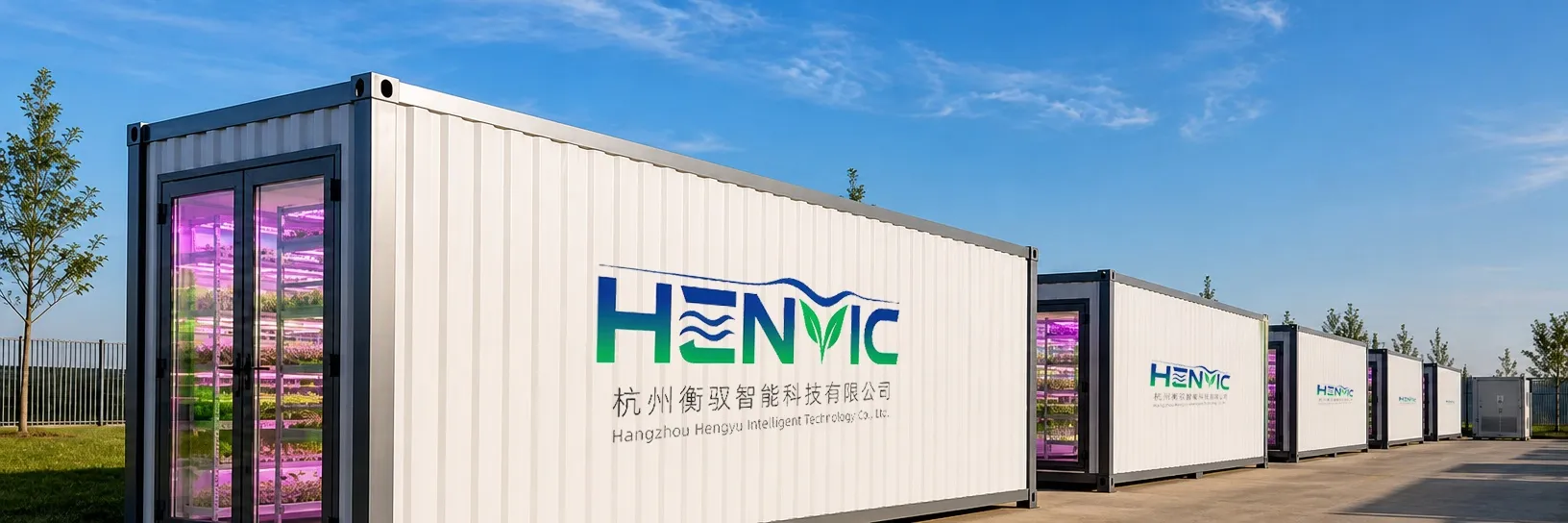
Leafy vegetables—lettuce, spinach, kale, pak choi, and their close relatives—are among the highest-value crops in controlled-environment agriculture. Because their harvestable organ is the leaf itself, their commercial quality is governed far more directly by the aerial environment than that of fruiting crops. Among all environmental variables, air temperature and relative humidity (RH) are the two most decisive, because together they determine the plant's transpiration rate, nutrient uptake, tissue water content, and disease susceptibility. In a leafy vegetable cultivation chamber—a sealed, LED-lit enclosure in which air exchange with the outside is deliberately minimized—temperature and humidity are not merely "set and forget" parameters. They must be managed as a coupled pair, because every attempt to cool the air increases its moisture-holding capacity, and every strategy that conserves energy by limiting ventilation drives humidity upward. This article reviews the physiological basis of temperature and humidity control, the optimal operating envelopes for leafy greens, the engineering systems used to regulate them, and the integrated control strategies that keep the two in balance.
2. Why Temperature and Humidity Matter for Leafy Greens
2.1 Temperature as the Master Regulator
Leafy vegetables are cool-season crops. Their photosynthetic machinery and cell expansion both function optimally in a narrow band, commonly cited as roughly 18–22 °C during the light period and 15–18 °C during the dark period, with root-zone temperatures held around 18–20 °C. When air temperature rises above the optimum, two problems emerge in quick succession. First, respiration accelerates faster than photosynthesis, so the plant burns the sugars it just produced; growth slows, leaves become thin, and yield drops. Second, leaf margins and young tissue suffer water stress even when the root zone is well supplied, because the vapor pressure gradient between the leaf interior and the air—the driving force for transpiration—becomes so steep that evaporation exceeds what the vascular system can replenish. The visible consequence is marginal necrosis, commonly called tipburn.
Temperature also sets the ceiling of achievable humidity control. Warm air holds more water vapor; a chamber kept at 28 °C and 80% RH contains roughly twice the absolute moisture of the same air at 18 °C and 80% RH. Cooling such air toward the dew point is therefore the primary mechanism by which a cultivation chamber condenses and removes moisture—but if the cooling surface is not distributed well across the canopy, local cold spots form and condensation falls directly onto the leaves, creating the very wetness that pathogens exploit.
2.2 Humidity, Transpiration, and Tipburn
Humidity acts through the same vapor-pressure gradient that temperature sets. It is most usefully expressed as vapor pressure deficit (VPD), the difference between the water vapor pressure inside the leaf (near saturation, since leaf cells are wet) and that of the surrounding air. High temperature raises VPD; high RH lowers it. Research on lettuce cultivated under different humidity regimes (50%, 70%, and 90% RH during the light period) has consistently shown that tipburn injury becomes more severe as RH rises, because a low VPD suppresses transpiration, calcium transport into young leaves stalls, and leaf edges die from localized calcium deficiency—even when the nutrient solution contains adequate calcium. This is a crucial insight for chamber design: tipburn in dense leafy canopies is usually an environmental problem, not a nutritional one, and its cure is a properly controlled VPD, not simply more calcium in the feed.
On the other side of the spectrum, excessively low humidity is equally harmful. Very high VPD closes the stomata to conserve water, photosynthesis drops, leaf edges curl, and fresh weight yield falls. The practical sweet spot for most leafy greens lies around 60–80% RH, or a VPD of roughly 0.8–1.2 kPa, adjusted upward slightly for dense canopies and advanced growth stages.
2.3 The Humidity–Disease–CO₂ Triangle
In a closed chamber, the inverse relationship between humidity and ventilation creates a dilemma. CO₂ enrichment (typically 800–1200 ppm) raises photosynthesis substantially, but it only works if ventilation is kept low enough to retain the gas. Low ventilation, however, traps transpired water, and stagnant high-humidity air is the prerequisite for fungal and bacterial disease—Botrytis in lettuce, downy mildew in spinach, and various bacterial soft-rot pathogens. The designer therefore faces a three-way trade-off: CO₂ retention pushes toward sealed operation, humidity control pushes toward ventilation and dehumidification, and temperature control must be accomplished largely without the free ventilation that a conventional greenhouse uses for cooling.
3. Optimal Operating Ranges
For a leafy vegetable cultivation chamber, the following envelopes summarize the mainstream practice, with adjustment for species and cultivar:
• Light-period air temperature: 18–22 °C (lettuce and similar greens; slightly higher for warm-season leafy crops such as some basils).
• Dark-period air temperature: 15–18 °C; the cooler night temperature is deliberately used to reduce respiration and conserve assimilates.
• Root-zone temperature: 18–20 °C; below about 15 °C, nutrient uptake and root activity decline sharply.
• Relative humidity: 60–80%, with the target lowered toward the upper end only as the canopy closes.
• VPD: approximately 0.8–1.2 kPa during active growth.
• Canopy-level air velocity: at least 0.5–0.9 m/s across the leaf surface, both to homogenize microclimate and to break up the humid boundary layer that otherwise forms around each leaf.
The last parameter deserves emphasis. In densely stacked leafy production, airflow distribution is often the hidden failure mode: temperature and humidity stratify vertically and horizontally, and leaves near the light source or near the cooling coil experience conditions far removed from the sensor reading taken at return-air position.
4. Temperature Control Systems
4.1 Cooling
Cooling in a cultivation chamber is dominated by three heat loads: the condensed-light-to-heat conversion of LED arrays (often several hundred watts per square meter of rack), the solar-equivalent radiation from the lighting itself, and the sensible heat of the air. Because the chamber is sealed, conventional roof ventilation cannot be used, so cooling is achieved through closed-loop air handling: air is drawn across chilled-water coils or direct-expansion coils in an air-handling unit and distributed through floor or ceiling ducts, often with a two-channel air-supply pattern that directs streams of tempered air horizontally through the canopy, mixing gently with the warmer, humid air in the crop layer and exhausting it back to the AHU. Such air-distribution designs have been shown to homogenize canopy temperature and simultaneously carry away moisture, achieving the best of both functions with less energy than separate systems.
4.2 Heating and Night Management
Heating is straightforward in principle but subtle in practice. At night, with the lights off, the heat load vanishes, and the chamber tends to drift toward the cooled set point. The dark-period set point is intentionally lower (15–18 °C) to suppress respiration, and heating is usually applied through the same water coils used for cooling, or through auxiliary heaters that maintain the minimum differential between air and root zone. The critical discipline is to avoid day-to-night temperature swings larger than about 5–6 °C: sudden drops stress leaf tissue, and sudden rises at light-on can trigger rapid VPD swings that the stomata cannot track.
4.3 Root-Zone Temperature
Root-zone temperature is controlled in the nutrient system itself: heat exchangers in the reservoir, insulated piping, and, in some designs, dedicated root-zone heat pumps. Keeping roots near 19 °C while air sits at 20 °C ensures that the water in the root cells remains liquid enough for active uptake—the counter-intuitive but well-documented phenomenon that cool roots warmed slightly above cold nutrient solution dramatically improve nutrient absorption and leaf-margin health.
5. Humidity Control Systems
5.1 The Hierarchy of Humidity Control
Humidity in a closed chamber is managed in layers:
1. Airflow homogenization. Before any dehumidification is attempted, the air must be well mixed. Ducted supply and exhaust design, canopy airspeed of roughly 0.9 m/s, and avoidance of dead zones are the cheapest and most effective first measures; they simultaneously reduce temperature stratification.
2. Condensation dehumidification. Cooling the air below its dew point on a chilled coil condenses water. This is the primary moisture sink in most chambers, and its capacity must be sized for the peak transpiration load of a mature, fully closed canopy.
3. Desiccant dehumidification. Where dew-point control must be deeper than chilled coils can provide, or where reheat of dehumidified air must be avoided, solid or liquid desiccants remove moisture at low temperature. Desiccant systems are particularly attractive when the sensible heat of the return air is used to regenerate the bed, or when the chamber is coupled to a heat pump.
4. Ventilation. In a semi-closed or dynamically insulated design, a controlled fraction of air is exchanged with the outside—often via heat-recovery exchangers—when ambient air is cooler and drier than chamber air. This is the only truly "free" humidity control, but it is limited by outdoor conditions and by the need to retain CO₂.
5.2 The Energy Penalty
Every gram of water removed by chilled-water dehumidification costs a significant fraction of a watt-hour of primary energy; removing the transpired moisture of a dense leafy crop can represent a large share of total chamber energy consumption. Strategies to reduce this penalty include: (i) lowering the target VPD just enough to control tipburn rather than追求 maximal ventilation; (ii) reusing the condensate for irrigation; (iii) recovering heat from the dehumidification process to pre-condition fresh air or nutrient solution; and (iv) scheduling dehumidification against off-peak electricity. In high-end leafy vegetable chambers, energy recovery from the cooling and dehumidification loop is increasingly viewed not as an option but as a design requirement.
6. Integrated Control Strategy
Modern cultivation chambers control temperature and humidity as a single coupled system, typically through a VPD-based set-point architecture rather than independent RH and temperature set points. The controller continuously computes the psychrometric state of the chamber from temperature and RH sensors distributed at canopy height, derives the current VPD, and drives the cooling, dehumidification, ventilation, and humidification equipment through cascade control:
• During the light period, the light-driven transpiration pulse is anticipated, and cooling/dehumidification capacity is pre-positioned.
• During the dark period, the focus shifts to humidity purge and temperature depression, with the aim of leaving the canopy dry going into the next morning.
• Alarms and model-predictive logic intervene when the dew point at the cooling coil approaches the canopy temperature, signaling imminent leaf condensation.
More advanced implementations use model-predictive control or learned models trained on historical growing data, forecasting the VPD trajectory from the planned light intensity and adjusting chilled-water valve positions accordingly. Some systems add machine-vision assessment of leaf water status as an early warning layer.
7. Conclusion
Temperature and humidity control in a leafy vegetable cultivation chamber is, at heart, the art of managing one coupled variable—the vapor pressure deficit of the canopy air—through an arsenal of cooling, dehumidification, ventilation, and airflow distribution. The physiology of leafy greens demands a narrow band: around 18–22 °C in light, 15–18 °C at night, 60–80% RH, and a VPD near 0.8–1.2 kPa. Engineering must deliver this band with minimal energy and without compromising CO₂ enrichment or canopy uniformity. As chambers grow denser, stack higher, and run longer cycles, the winning designs will be those that treat temperature and humidity not as separate subsystems to be tuned by hand, but as a single, dynamically controlled ecological variable—one that the plant itself constantly reads and the controller must constantly anticipate.