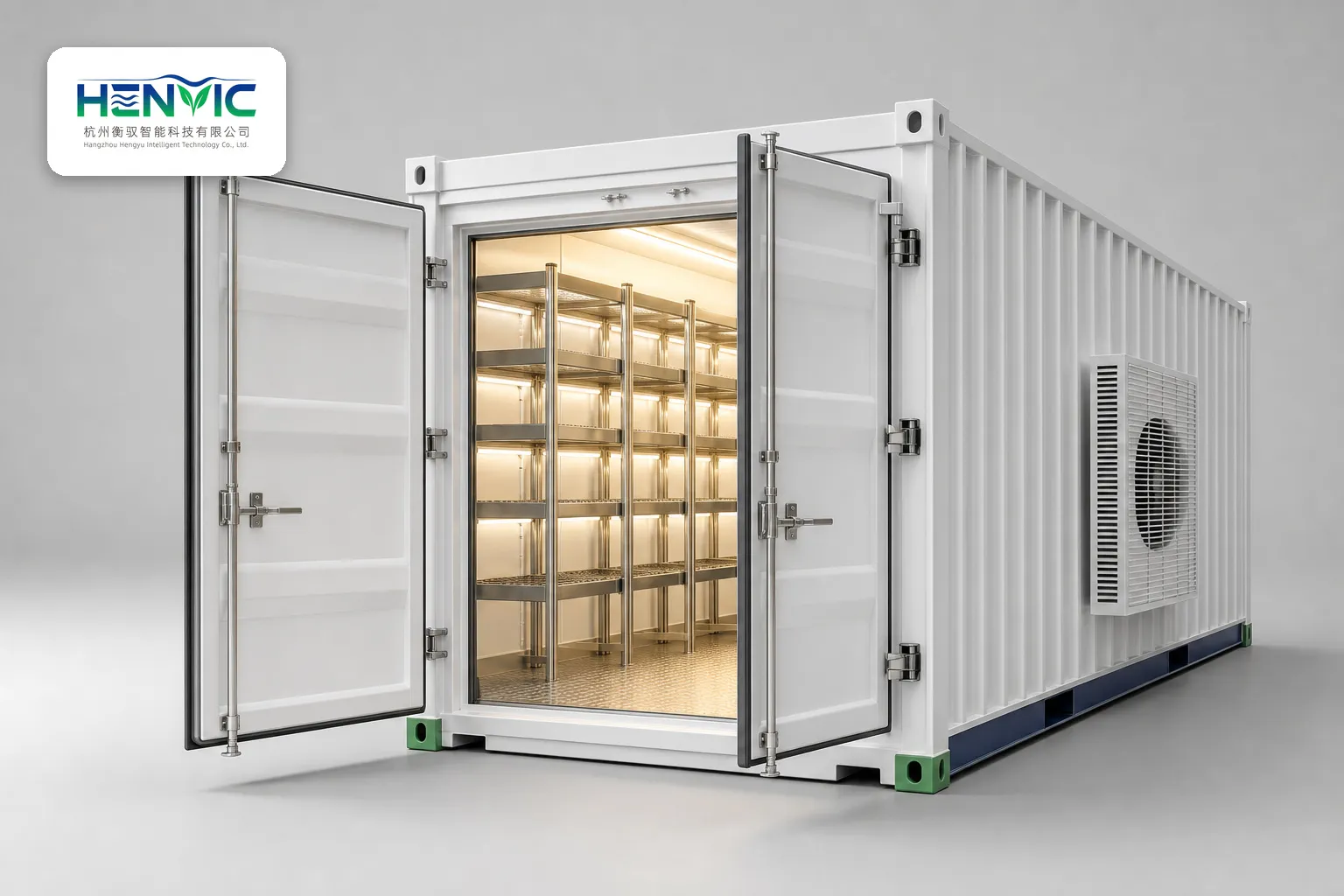
1. What the Category Actually Is
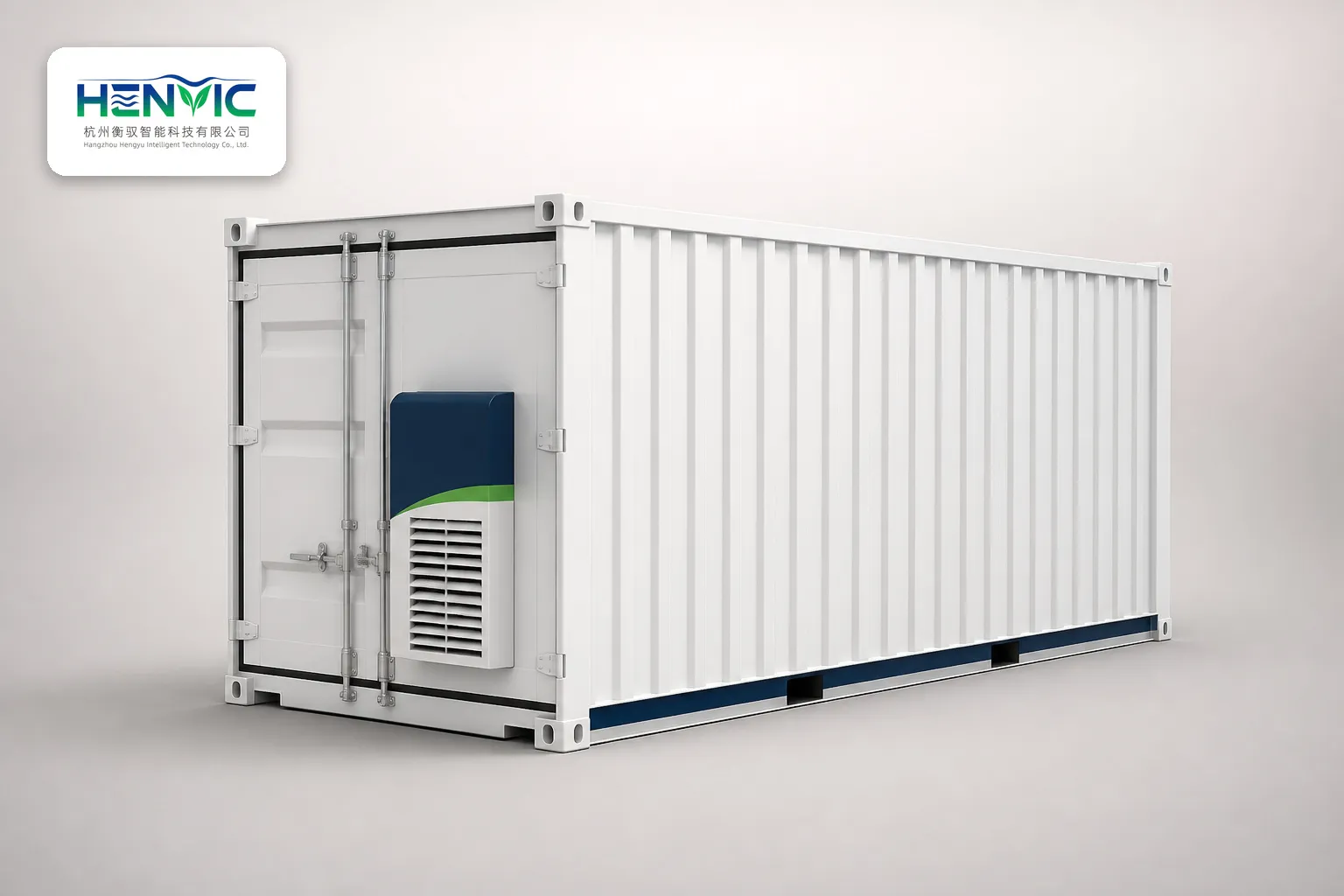
A "mushroom cultivation container" is a factory-built, self-contained growing environment — usually housed in a shipping-container-derived or purpose-fabricated insulated module — that delivers full control over the six variables that determine fungal yield: temperature, relative humidity, carbon dioxide, air movement, light, and sanitation state. The industry also labels these units grow pods, mobile mushroom farms, CEA mushroom rooms, containerized fruiting chambers, and, in the more specific case where the container only fruits (with incubation done elsewhere), fruiting rooms on wheels.
The important distinction that many buyers miss: a container is not a complete farm. It is one stage of a production line, enclosed in a shell. Serious operations separate substrate preparation / pasteurization, spawning and incubation, fruiting/harvest, and post-harvest handling into dedicated spaces, because each stage wants contradictory conditions. A single container doing all four is a compromise; a fleet of containers each locked to one stage is an architecture.
2. Why Containers Won Attention
Three structural drivers pushed this format from novelty to a standard option in the controlled-environment-agriculture catalogue.
Capital and permitting arbitrage. A containerized module is typically procured as equipment rather than as a building, which in many jurisdictions avoids or shortens the construction-permit path, reduces foundation work, and keeps the asset on a depreciation schedule that is easier to justify for a pilot. Deployment is measured in weeks, not months, and the unit is relocatable — a genuine hedge for operators who do not own land or who are testing a market before committing.
Environmental determinism. Fungi are far less forgiving of drift than leafy greens. A fruiting room held 2 °C above target with CO₂ unmanaged produces long-stemmed, cap-less, low-grade product within days. A well-insulated shell with a properly sized climate unit delivers repeatability that a retrobarn or basement cannot, and repeatability is what converts growing into a business.
Contamination economics. Trichoderma (green mold), Cobweb (Spizellomyces/Myociboria-type aerial hyphae), bacterial blotch and fungal competitors scale with every air exchange through an unfiltered opening. A sealed, positively filtered module materially reduces the loss rate, and in mushroom farming loss rate is the margin.
3. System Architecture: What Is Inside the Shell
3.1 Envelope and insulation
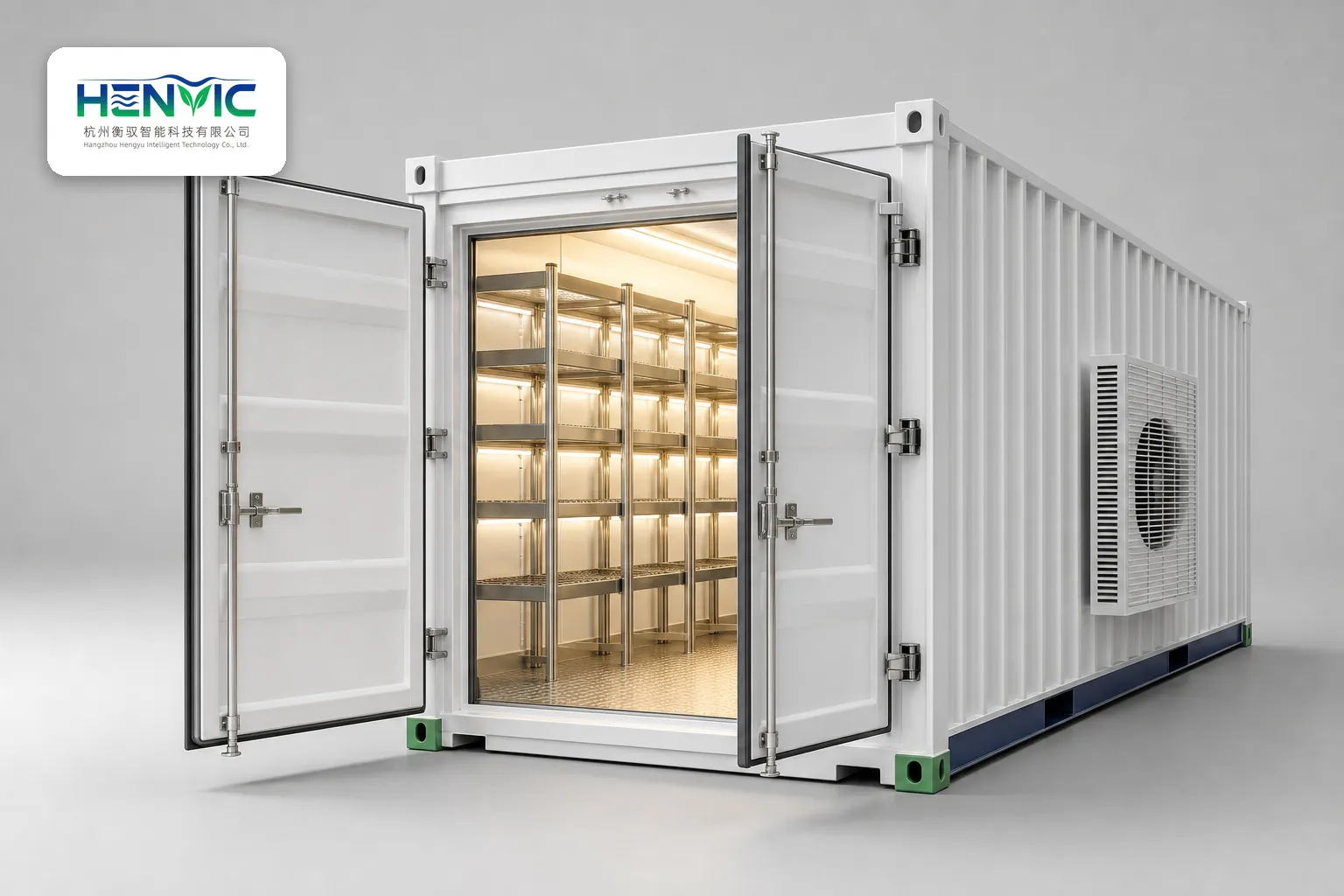
The load-bearing shell is weathering-steel or a fabricated panel box; the growing interior is lined with food-grade, cleanable surfaces — typically PU/PIR or rock-wool sandwich panels with stainless or coated-steel facing. Two design details separate professional units from marketing photos:
- Thermal bridging at the frame. A steel container frame conducts outside temperature straight into the interior; without a thermal break, the frame becomes a condensation surface and a mold farm. Purpose-built panel boxes avoid this far more cleanly than a converted box.
- Floor and drainage. Fruiting rooms are wet. A sloped wash-down floor with a trapped drain is mandatory for hose-cleaning; a "sealed floor with no drain" is a red flag in a spec sheet.
3.2 Climate unit
The HVAC package must handle a peculiar load profile: latent-dominated with a modest sensible load. Transpiring substrate and evaporating surface water generate large moisture loads, while metabolic heat from mycelium is real but small. Sizing the unit by cubic metres alone is the single most common engineering error in this market. Correct sizing requires:
- Evaporative load at maximum stocking density and maximum humidity setpoint.
- Metabolic heat release during the colonisation-to-priming transition.
- Fresh-air load — the energy cost of bringing outside air to setpoint, which dominates in extreme climates and is why heat-recovery ventilators (HRV/ERV) and enthalpy wheels appear on serious units.
- Defrost and reheat margins, since evaporator coils run cold in high-humidity air.
Typical configuration is a refrigerated dehumidification circuit paired with electric or hot-water reheat, plus an ultrasonic or high-pressure fogging line for humidification, and a CO₂ control loop driven by fresh-air dampers and, in higher-end builds, demand-controlled ventilation.
3.3 Air distribution and filtration
Uniformity matters more than the setpoint itself. A room where the shelf nearest the supply reads 90% RH and the far corner reads 78% produces two harvest grades from one batch. Engineering answers include ducted supply with return at the opposite end, low-velocity dispersion, and circulation fans that move air over the crop without directing it onto the pins — mushrooms desiccate under direct airflow and the caps crack.
Filtration is normally specified at MERV/ISO coarse-to-fine prefiltration plus a HEPA stage on the fresh-air path. Full sterile-room grade is unnecessary for most fruiting rooms but is genuinely valuable in incubation and inoculation spaces, where airborne Neurospora, Aspergillus, and bacterial spores are the operative risk.
3.4 Racking and load path
Vertical racks (angled or straight shelving, or gavel/stack systems that let trays be lifted in and out as a column) define the harvest ergonomics. The often-overlooked constraint is water weight: a saturated substrate block can be heavy enough that a fully loaded rack in a container floor exceeds naive assumptions, and rack-to-rack spacing must permit both a person to work the face and a cart to move. Blocking spacing for airflow and spacing for a human body are different numbers, and cheap units optimise the wrong one.
3.5 Sterilisation and pasteurisation interface
Container units generally do not include substrate sterilisation. That is done in a separate atmospheric or pressure pasteuriser/steriliser tunnel, an autoclave, or a "still-air" pasteurisation chamber, and the substrate is transferred into the container for spawning, incubation or fruiting. Vendors who claim a single container does everything are describing sequential operation inside one room with one air path — a contamination and scheduling problem, not a feature.
3.6 Controls, sensing and data
A competent control layer runs cascaded loops on temperature, RH and CO₂, logs every channel, alarms on deviation, and exposes setpoint recipes per stage. Two features distinguish industrial-grade from hobby-grade: redundant sensing at both ends of the room (not one sensor at the controller), and fail-safe behaviour on power loss or sensor fault — a fogging line that stays open on a failed RH reading will flood a room overnight.
4. The Biology the Machine Must Serve
4.1 Stage-specific setpoints
Fungal production is a sequence of contradictory demands, and the container's job is to move between them fast and predictably.
| Stage | Temperature | RH | CO₂ | Air / Light |
|---|---|---|---|---|
| Spawn run / colonisation | Species-specific, typically warm (roughly 20–26 °C for many Pleurotus and Agaricus work; cooler for Lentinula) | Substrate-bound; room RH moderate | High tolerated, often deliberately elevated to suppress early pinning | Minimal air movement, no light requirement |
| Pinning / induction | Down-shift, often 5–10 °C below colonisation temp, plus fresh-air step change | High | Dropped sharply — this is the primary trigger | Diffuse light on a diurnal cycle for most species |
| Fruiting / bulking | Held in band, tight tolerance | High but not saturated on the caps | Continuous removal; the limiting factor in dense stocking | Even, indirect circulation; light cycle for cap development and colour |
| Harvest window | Stable | Managed to avoid cap wetness at harvest | — | Harvest hygiene dominates |
Exact numbers are species-, strain- and substrate-dependent. The industry-relevant point is that the container must be able to execute a step change on demand, not merely hold a constant. A unit with slow thermal response cannot do a proper cold shock, and cold shock plus CO₂ drop is what makes pins form synchronously — which is what makes harvests predictable and labour schedulable.
4.2 Species segmentation of the market
- Oyster (Pleurotus) — the default entry crop: forgiving, fast, grows on pasteurised straw and waste streams, tolerates more environmental sloppiness. This is where most container vendors start and where most pilot failures are actually not the container's fault.
- Shiitake / Lentinula — log- or sawdust-block based, longer cycles, requires a genuine temperature and moisture cycling regime plus rehydration; container economics depend on block throughput rather than cycle count.
- Button / Portobello (Agaricus) — the industrial mainstream, but it requires spawn running on compost at elevated temperature, then casing-layer management, then a spawn-run phase with heavy CO₂ tolerance followed by a vigorous fresh-air and casing-cooling regime. Agaricus is the least container-friendly of the major crops because its compost preparation is a multi-day open-tunnel process; container formats here usually handle fruiting only.
- Lion's mane, maitake, king oyster, reishi, cordyceps — the functional/high-value segment. Medicinal bodies and fruiting polysaccharide crops reward precisely the control that containers provide, and they carry the price per kilogram that justifies the capital. This is the fastest-moving commercial niche.
- Micro-fruiting and grow kits — a container as a kit production line rather than a fresh-mushroom line; a different business with different economics.
5. Unit Economics: What Actually Determines Viability
The container is only a fraction of the cost stack. A credible feasibility model covers:
Capital. Module and climate package; racks and trays; the substrate line (chop, mix, hydrate, pasteurise/sterilise, cool); inoculation space; cold storage and packaging; transport, crane/set, electrical service, water and drainage. Electrical service and a condensate/waste-water path are the two most frequently unbudgeted items — a container can be delivered to a site that cannot feed it.
Operating. Electricity, dominated by dehumidification and refrigeration in warm-humid climates and by heating plus ventilation in cold climates; substrate and supplement cost; spawn; labour, which is the largest single line in fresh mushroom production because harvesting is still hand work; packaging; and the loss rate, which is the line that separates profitable operations from quietly failing ones.
Yield accounting. The honest metric is kilograms of saleable Grade-A product per square metre of growing face per week, not biological efficiency (BE%) alone. BE — fresh weight yield relative to dry substrate weight — is useful for comparing substrates, but a container with high BE and low turnover can be beaten by a lower-BE operation running more flushes per unit time with tighter scheduling.
Throughput vs. redundancy. A single container has no redundancy: one compressor failure, one contamination event, one harvest-labour gap, and the whole pipeline stalls. Commercial deployments therefore almost always use N+1 modules with staggered cycles, so that a room coming off fruiting is available while another is being cleaned and reloaded. Staggering is the actual product; the container is the component.
6. Business Models in This Segment
Direct-to-restaurant and specialty-farmer micro-production. Short supply chain, premium pricing, high-value and unusual species that wholesale channels will not take. The container's value proposition is speed to market and the ability to prove demand before investing in a building.
Equipment-as-a-product vendors. Manufacturers sell turnkey pods, sometimes bundled with substrate blocks, spawn and a training programme. Here the durable revenue is consumables and service, not the box — which explains why so many vendors emphasise "farm in a box" simplicity while their real margin sits in recurring supply.
Franchise / licensed pod networks. Standardised pods plus centrally produced substrate and spawn, with the operator only running fruiting and harvest. This is the most operationally robust model because it moves the hardest step (contamination-controlled substrate preparation) to a central facility, and it is where container format genuinely shines.
Institutional and resilience use. Schools, hospitals, correctional and remote/aid settings, where the appeal is closed-loop food production on a small footprint using waste substrates. Economics are secondary to mission, and the specification priorities differ accordingly.
R&D and strain-validation platforms. Universities and biotech firms use small controlled pods as repeatable phenotyping chambers for strain trials, substrate trials and extraction-feedstock production.
7. Standards, Food Safety and Compliance
Mushrooms are a ready-to-eat, high-moisture, soil-adjacent product, which places them in a sensitive food-safety position. Real compliance considerations include:
- Food-safety regime by market: HACCP-based plans, produce-safety requirements under the applicable fresh-produce rules in the operator's jurisdiction, and third-party audit schemes (GFSI-benchmarked certification) if supplying retail or foodservice chains. Container operators frequently discover that an audit asks about water source, condensate management, cleaning chemical control and traceability long before it asks about the growing environment.
- Traceability: batch identity from substrate lot and spawn lot through to harvest date and pack line. A control system that logs room conditions per batch is a compliance asset, not just a yield tool.
- Electrical and machinery conformity: the climate package, wiring and pressure vessels must carry the applicable regional certifications (for example CE/UKCA, UL/NEMA ratings, or equivalent national marks). Imported pods with uncertified electrical assemblies are a documented failure mode in this market, both for insurance and for inspection.
- Structural and siting rules: even where a pod is treated as equipment, local rules on foundations, setbacks, refrigerant handling, noise and condensate/waste-water discharge usually apply.
- Worker safety: high-humidity cold rooms plus wet floors plus lifting loads is a genuine ergonomic and slip-risk combination; CO₂ accumulation in an unoccupied sealed room is a confined-space-adjacent hazard worth a procedure.
Because requirements vary by country, state and municipality, and are revised regularly, any of the above should be confirmed against the current authority text for the specific site rather than assumed from a vendor's compliance claim.
8. Failure Modes Observed in the Field
- Undersized dehumidification. Vendors quote cooling capacity; the room needs latent capacity. Result: condensation on walls and ceiling, wet caps, bacterial blotch.
- Single-sensor control. One hygrometer at the controller reads fine while the crop face at the far end is 12% drier.
- Direct airflow onto pins. Cap desiccation, cracking, and abnormal morphology; also accelerates spore dispersal across the room.
- No true clean-out design. Spray walls that don't drain, rack feet that trap slurry, and unfiltered return air turn each cycle into a escalating contamination load. Green-mold pressure in a poorly cleaned pod typically worsens batch over batch.
- Ignoring the substrate line. Contaminated or inconsistently pasteurised substrate cannot be rescued by an excellent fruiting room. A large share of "the container doesn't work" complaints trace to spawn, substrate moisture content, or cooling after pasteurisation.
- No cold-shock capability. Units sized only to hold a setpoint cannot execute the temperature and CO₂ step change that synchronises pinning; yields become lumpy and unpredictable.
- Unbudgeted infrastructure. No three-phase supply, no condensate path, no water, no floor drain, no dock or crane access for delivery and set.
- Cycle-time optimism. Realistic models include cleaning, drying, loading, spawn-run, rest between flushes and a genuine fallow allowance. Plans built on continuous back-to-back harvest rarely survive contact with labour.
9. Buyer's Due-Diligence Checklist
- Ask for latent-load sizing calculations, not just cooling capacity, and for the assumed maximum stocking density and RH setpoint.
- Demand dual-end sensing and a documented fail-safe on fogging and heating.
- Verify fresh-air heat recovery if the site climate is extreme; otherwise expect the ventilation energy to dominate the bill.
- Confirm rack and floor load capacity with wet substrate, and check that a person and a cart can both work the face.
- Insist on drainage, wash-down rating, and cleanable surfaces — and ask specifically about rack feet, cable penetrations and light fittings as contamination traps.
- Get electrical and refrigerant certifications in the destination jurisdiction, in writing, with model numbers.
- Test the step-change response: how long from a 24 °C colonisation hold to a 15 °C pinning trigger at 90% RH and 800 ppm CO₂? That number is the machine's real specification.
- Ask what the vendor supplies after the box: substrate, spawn, technical support, service SLA, spare parts lead time. A pod with a four-week compressor lead time is four weeks of lost crop.
- Run the economics on saleable Grade-A kg per m² per week, with a stated loss rate and a fallow allowance.
- If possible, visit a unit at least six months into operation, not a showroom. Contamination and service problems are time-dependent.
10. Where the Segment Is Heading
The direction of travel is toward systems rather than boxes. Expect tighter integration of substrate supply with fruiting modules, so that the operator buys a production rate rather than a room; more model-predictive climate control that manages CO₂, vapour-pressure-deficit and temperature as coupled variables instead of three independent setpoints; energy-recovery and heat-pump architectures as electricity cost becomes the binding constraint; and species-upward migration into high-value functional and medicinal crops, where the control precision a container provides translates directly into price rather than into volume.
On the supply side, the market is consolidating around vendors who can document food-safety design, provide verified load sizing, and support a fleet rather than a single unit — because the operators who survive are the ones running staggered multi-room cycles with a consumables pipeline behind them.
A realistic framing for anyone entering this space: the container solves the environment problem, which is the easier half. The hard half is substrate quality, spawn viability, contamination discipline, harvest labour and market access. A well-specified pod makes those solvable; it does not make them unnecessary.
Note on evidence: this guide describes established engineering practice, standard stage-management logic and commonly observed commercial models in containerised mushroom production. Setpoint ranges, sizing logic and yield metrics are given as typical engineering bands rather than fixed values, since they depend on species, strain, substrate and site climate. Regulatory and certification requirements differ by country, state and municipality and are revised over time — confirm against the current text of the applicable authority for a specific site before committing to a build. No specific market-size figures or vendor names are asserted here, as they were not verifiable from reliable sources at the time of writing.