What the 40 square metres actually means
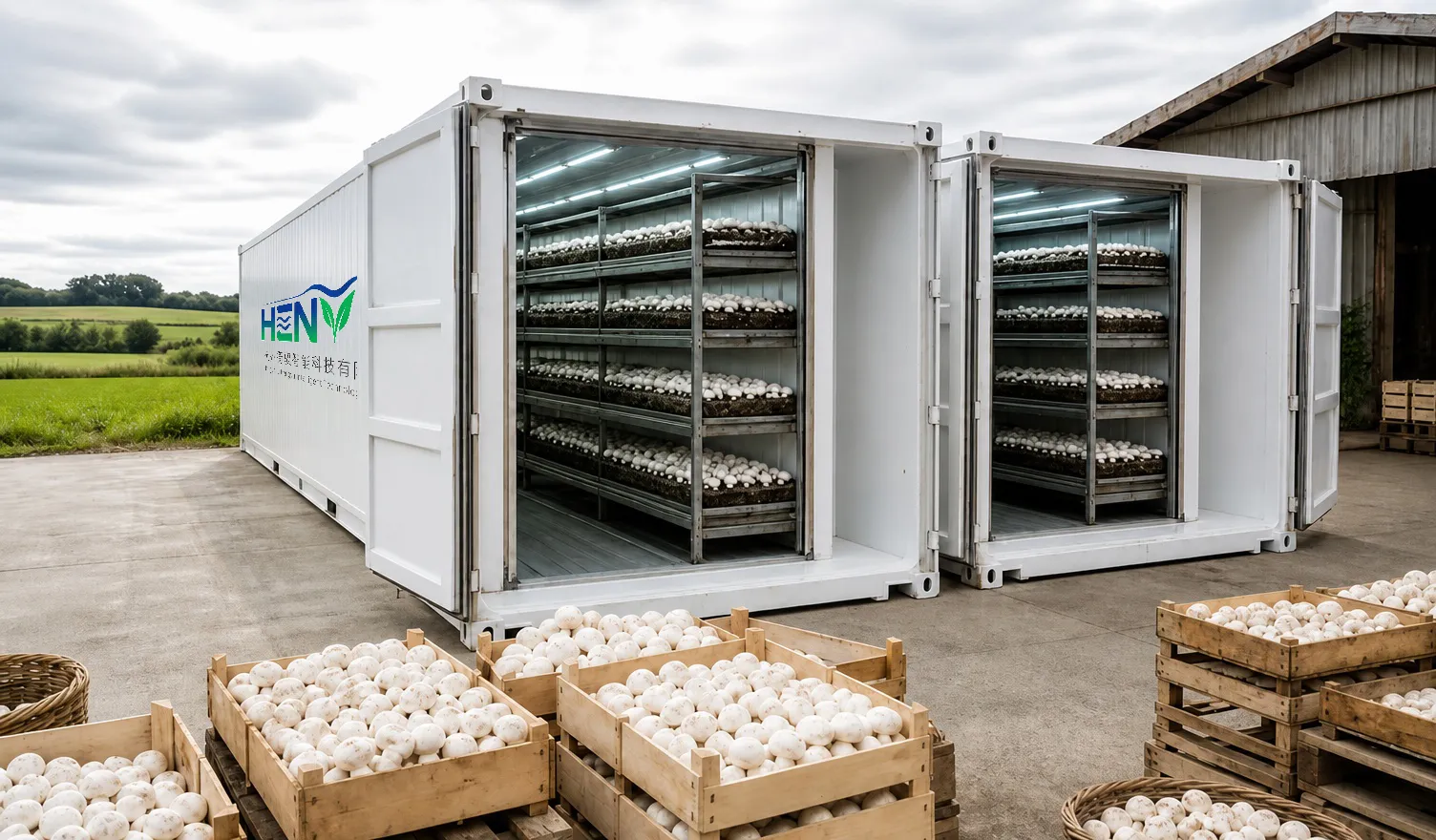
The figure refers to footprint, not growing area. A standard forty-foot high-cube container has an internal floor of roughly 28 to 30 square metres; with a nominal allowance the marketing number rounds to 40. Inside that footprint, crops are grown on vertical racks. Four to six tiers are common, and after subtracting aisles and service space, the usable growing area typically lands somewhere between 100 and 140 square metres.
That gap between footprint and growing surface is the first entry in the ledger. The container does not create more land. It multiplies the land it has by stacking. Every additional tier is productive area gained without a single extra square metre of ground—and every additional tier is also more lighting, more cooling load and more equipment to depreciate.
The yield side: density, weight, cycles
Take lettuce as the reference crop. A well-managed hydroponic bench holds roughly 20 to 30 plants per square metre. If each head is harvested at 250 to 300 grams, that is about 6 to 9 kilograms per square metre per cycle.
To reach 10,000 kilograms a year on roughly 120 square metres of growing area, the arithmetic needs the upper end of every assumption: about 30 plants per square metre, heads closer to 300 grams, and 10 to 12 cycles per year rather than the 8 or 9 a conservative operator would budget. Crunch the middle-of-the-road numbers—120 square metres, 6 kilograms per square metre, 9 cycles—and the output is closer to 6,500 kilograms. Push to 140 square metres of growing area at 8 kilograms and 10 cycles and the figure passes 11,000 kilograms.
So the 10-tonne number is achievable, but it sits at the aggressive end of the range. It is a target that assumes fast-cycling leafy varieties, dense planting, short turnarounds, and very little downtime between crops.
The energy ledger
Here the honest accounting begins. Fully artificial-light growing means the sun is replaced with electricity, and the bill is not small.
A lighting load to deliver roughly 200 micromoles per square metre per second of photosynthetically active radiation over 120 to 140 square metres of canopy works out to something in the range of 11 to 15 kilowatts of LED capacity at current fixture efficiencies. Run those lights 16 to 18 hours a day and the lighting alone draws on the order of 180 to 250 kilowatt-hours a day.
Climate control is the other major consumer. Cooling a sealed box against the heat that lights and plants themselves generate, plus dehumidification, air circulation, nutrient pumping and controls, often adds 40 to 50 percent on top of the lighting figure. All told, a working container farm of this scale commonly sits in the range of 400 to 600 kilowatt-hours per day, which annualises to somewhere between 150,000 and 220,000 kilowatt-hours a year.
Divided by 10 tonnes, that is roughly 15 to 22 kilowatt-hours per kilogram of produce. The industry's published figures for container and vertical farms generally fall between 10 and 40 kilowatt-hours per kilogram, so the estimate is squarely inside the expected band.
What that energy costs
The cost of power is where the model either works or does not.
At 10 US cents per kilowatt-hour and 180,000 kilowatt-hours a year, electricity runs to about 18,000 dollars, or roughly 1.80 dollars per kilogram of produce. At 20 cents per kilowatt-hour—routine in many European and island markets—the same farm spends 36,000 dollars a year and the electricity cost alone reaches about 3.60 dollars per kilogram.
Set that against the wholesale price of a head of lettuce in most commodity markets—frequently under a dollar, sometimes well under—and the tension is obvious. The container farm cannot compete on the price of ordinary vegetables sold in bulk. It survives on premium channels: restaurants, high-end grocers, direct-to-consumer subscriptions and buyers who pay for proximity, freshness and traceability rather than for the cheapest possible leaf.
Everything else in the operating cost sits below electricity but still matters. A single skilled grower-operator costs somewhere between 30,000 and 50,000 dollars a year. Consumables—nutrient salts, growing media, seed, packaging—add more. And the capital cost of the unit itself, commonly cited between 80,000 and 150,000 dollars depending on automation, has to be spread across several years of production before the venture turns a profit.
Water and the other savings
The ledger is not all outgoings. Recirculating hydroponics uses a few litres of water per kilogram of produce, against the 200-plus litres per kilogram typical of open-field vegetable growing. That is a reduction of well over 90 percent—the single most favourable line in the account, and a genuine advantage in water-scarce regions.
Pesticides largely disappear, because the sealed environment keeps most pests out. Land use per unit of output falls by orders of magnitude. Transport distances shrink when the farm sits inside or beside the city it feeds. These are real benefits, and they matter increasingly as water, arable land and supply-chain resilience become harder to take for granted.
Where the numbers break
The 10-tonne figure is fragile in a few specific ways.
If the crop mix shifts from fast leafy greens to fruiting vegetables—tomatoes, peppers, strawberries—the cycles per year collapse, the crop occupies its space far longer, and the annual tonnage per square metre falls sharply. Fruiting crops are also more energy-hungry per kilogram. The headline number is essentially a leaf-crop number.
If electricity is expensive, or if the grid is carbon-intensive, the farm's environmental story collapses along with its economics. Artificial-light growing on a coal-heavy grid can carry a higher carbon footprint per kilogram than field cultivation; the green credentials only hold where the power supply is clean or where the farm is paired with its own renewable generation.
And if the farm runs below its optimistic assumptions—a few days lost to a breakdown, a crop lost to a root-zone problem, a sales channel that cannot absorb the full volume—the effective annual output drops quickly. The 10 tonnes is a ceiling reached under continuous, disciplined operation, not a floor guaranteed by the equipment.
The bottom line of the ledger
Forty square metres producing 10 tonnes a year is a defensible figure, but it is the product of stacked assumptions: multi-tier growing to multiply the area, dense planting and short cycles to maximise turns, and continuous operation to avoid gaps. It comes with an energy cost of roughly 15 to 22 kilowatt-hours per kilogram, which translates into electricity spending of two to four dollars per kilogram at typical rates—far above the wholesale value of ordinary produce.
Read plainly, the technical account says this: the container farm is not a cheaper way to grow vegetables. It is a way to grow them in places and seasons where they otherwise could not be grown, at a cost that only premium customers, scarce-land settings or high-value crops can justify. The 10 tonnes is real. The question the ledger forces is always the same—who pays for the kilowatt-hours, and whether the price they pay is worth what the box can deliver.